Number Match - Number Games
EasybrainPuzzle
4.812.81K Reviews
- Version
- 1.49.0
- Installs
- 50.00M
- Age Rating
- Everyone
Screenshots
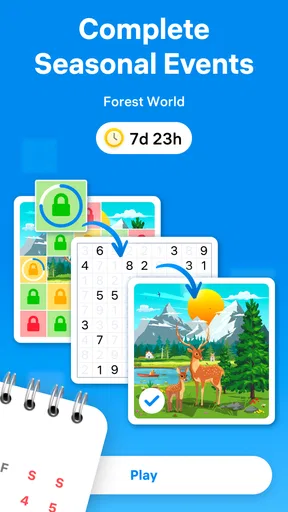
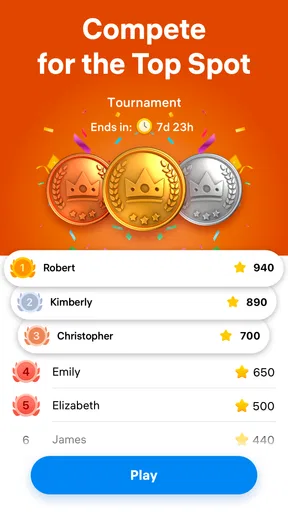
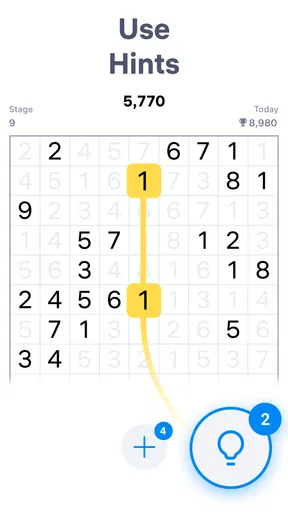
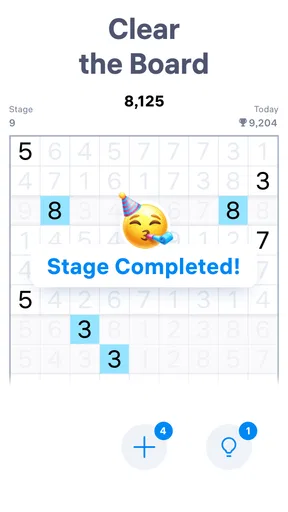
Our Review of Number Match - Number Games
 Analysis by Appyee
I spent time with Number Match - Number Games as a compact number puzzle from Easybrain, and my first impression was that its appeal comes from a very simple decision: find matching numbers or pairs that add up to ten, then clear them from the board. That idea is easy to understand, but it creates more tension than the cheerful presentation suggests. A move that looks useful now can remove the wrong options and leave a stubborn layout later.
This is a free puzzle game for Android, available for Everyone, and it has clearly found a large audience with more than 50 million installs. Its average score sits at 4.8 from roughly 604 thousand ratings, which tells me that the basic loop works for many players. I would not treat that score as a guarantee that it will suit everyone, though. The experience is deliberately repetitive, and people who want a story, action, or a deep collection of mechanics may find it too narrow.
How the number board feels after the first few rounds
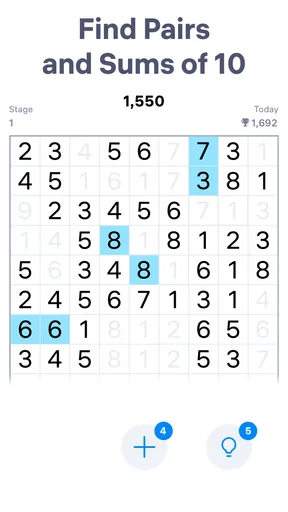
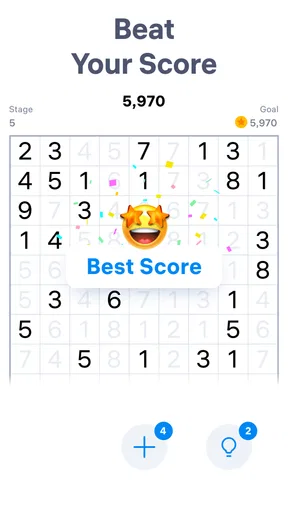
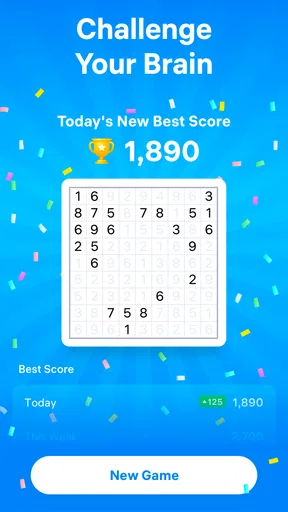
The opening is approachable because there is no complicated rulebook to learn. I scan the grid, look for identical values or combinations that total ten, and tap the pairs I want to remove. That low barrier is one of the game's strongest qualities. I can start a round while waiting for a kettle to boil, understand the objective immediately, and stop without needing to remember a plot or a long-term mission.
The challenge comes from choosing between an obvious move and a useful move. Clearing a pair is not always progress in the strategic sense. Sometimes it exposes a better connection; sometimes it leaves isolated numbers that are difficult to use. I found myself slowing down once the board became less generous, checking several possible matches before committing. That small pause is where the brain-training angle feels most convincing: the game rewards visual scanning, short-term planning, and patience rather than quick tapping.
One practical habit helped me more than simply hunting for the first available pair. I started reading the board in lines, then checking whether a removal would make a new number pair visible. That approach reduced random moves and made the later part of a round feel more deliberate. It is a useful distinction for new players: the goal is not merely to remove numbers, but to preserve future connections.
The interface is best suited to short sessions. I can play for a few minutes without feeling that I need to settle in, yet a promising board can keep me involved longer than expected. This makes it a good companion for commutes, waiting rooms, or a quiet break. It is less suitable when I want a single, clearly bounded puzzle with a guaranteed solution path, because the appeal depends on repeatedly examining and rearranging the same kind of numerical problem.
Progress without turning the game into a chore
Number Match does not need a character, a map, or a campaign narrative to create momentum. My progress comes from becoming better at seeing relationships on a crowded board. Early rounds teach the visual language; later situations test whether I can avoid spending a useful number too soon. That is a modest form of progression, but it is honest. I am improving my reading of the puzzle rather than simply unlocking decorative content.
The trade-off is that the game can feel flat if I need constant novelty. A traditional crossword gives me changing clues, a Sudoku app gives me a different logical structure, and a match-three game usually adds cascading motion and special effects. Here, the satisfaction is quieter. It comes from spotting a connection that was easy to miss and recovering a board that initially looked awkward.
I would especially recommend it to players who enjoy number-based puzzles but do not want the strict, methodical rhythm of Sudoku. Sudoku asks me to reason about rows, columns, and regions; this game asks me to notice pair relationships across a more open field. Someone who prefers wordplay may get more lasting enjoyment from a crossword, while someone who wants fast feedback may prefer a conventional tile-matching game. Number Match occupies the middle ground: slower than an arcade puzzle, but more immediately accessible than a formal logic grid.
Where pressure comes from when money is involved
The game is free to download and play, which makes trying it low-risk from a purchase standpoint. There are in-app purchases listed at $14.99 per item. That is the spending detail I would pay attention to before handing the phone to a child or allowing unrestricted purchases. The Everyone rating makes the game broadly approachable, but an age label does not replace sensible purchase controls on a shared device.
I did not find the purchase information alone enough to conclude that spending is necessary for ordinary enjoyment. The important question for me is whether a player can engage with the central number-clearing activity without feeling pushed toward a payment. Since the purchase amount is significant for an optional mobile-game item, I would make sure the device requires confirmation before any transaction. That is a practical safeguard, especially for families.
My advice is to treat the paid items as a boundary decision rather than part of the core puzzle skill. If I am enjoying the game because I like finding pairs, I should first decide whether that activity is satisfying on its own. Spending should not become a way to compensate for rushing through a board or for expecting every round to feel effortless. A puzzle is more rewarding when I understand why a move worked, not when progress feels attached to a purchase.
There is also a psychological pressure that does not require a price tag: the temptation to keep trying after a poor decision. Because the rules are simple, I can easily tell myself that the next attempt will go better. I found it useful to stop after a few careless rounds instead of treating persistence as proof that I was improving. Short breaks made the game feel like a mental exercise rather than an obligation.
Fairness, skill, and the right expectations
From a fairness perspective, I judge this game mainly by how clearly it lets the player understand the relationship between a move and its result. The central rule is visible: identical numbers or compatible pairs can be removed. That clarity gives me a reasonable basis for learning. When I make a mistake, I can usually trace it to overlooking an option or using a number too early, rather than to a complicated control scheme.
That does not mean every moment feels equally fair. Number puzzles can become frustrating when the board offers few attractive connections, particularly if I have already removed several useful values. The frustration is part of the format, but it changes how I evaluate the game. I would not choose it when I need a guaranteed relaxation experience. I would choose it when I am comfortable with uncertainty and willing to inspect the board carefully instead of expecting constant easy wins.
The game also feels more skill-based than reflex-based. Fast fingers do not solve a board if the chosen pair damages the next sequence. A player who takes time to survey the layout can often make better decisions than someone who taps rapidly. That makes it a better fit for thoughtful puzzle fans than for people looking for a competitive action challenge.
I would be cautious about comparing personal progress with other players. The verified public figures show strong overall popularity, but they do not tell me that the game provides a balanced competitive ladder or a meaningful ranking system. I therefore see it primarily as a personal puzzle, not as a fair esports-style contest. Its strongest competition is with my own attention span and pattern-recognition habits.
That distinction matters when deciding whether to install it. If I want to beat friends through a clearly defined leaderboard, I would look for a game built around that purpose. If I want a private challenge that I can pick up whenever I have a spare moment, Number Match makes more sense. It does not need competitive pressure to justify its place on my phone.
Small techniques that make difficult boards less frustrating
My most useful technique was to avoid clearing every immediately visible pair. I first searched for duplicates that appeared in several possible combinations, because a flexible number can be more valuable than a pair that has only one obvious use. This is not a complicated system, but it changes the way I read the board: I am managing options, not just removing clutter.
A second technique was to scan from both ends of a line rather than moving in only one direction. That made it easier to notice relationships separated by other numbers and prevented me from assuming that the first available match was the best one. When the board looked crowded, I mentally grouped similar values before tapping. The extra second often revealed a cleaner sequence.
I also learned to use a failed attempt as information. If a board becomes blocked, I try to remember which early removal created the problem. On the next round, I delay that type of move and test a different order. This turns repetition into practice. Without that reflection, the game can become a cycle of tapping pairs and hoping the layout improves.
For a quick everyday session, I would set a simple stopping point: one or two focused rounds, then put the phone away. That keeps the game useful as a break instead of allowing a frustrating board to dominate the whole pause. For a longer session, I would change my goal from clearing quickly to making fewer impulsive moves. The second goal is more realistic and gives the puzzle a stronger mental-training quality.
What I would want to know before installing
The current version is 1.48.0, and the listed minimum operating system is Android 8.0. That makes compatibility straightforward for many Android phones, though anyone using an older device should check the system version before downloading. The game is also available in the broader Android and iOS app landscape, so it is not limited to one kind of mobile player.
A common question is whether this is suitable for children. The Everyone content rating suggests that the puzzle itself is broadly appropriate, and the rules are simple enough for a child who understands basic numbers. My concern would be the purchase setting rather than the puzzle content. On a family device, I would enable purchase approval and let the child play independently only after checking those controls.
Another question is whether it works for someone who dislikes mathematics. In my experience, it feels closer to visual sorting than to school-style calculation. The arithmetic is light, while the real task is noticing pairs and planning removals. Still, anyone who dislikes repetitive number patterns may lose interest quickly, even if the rules are easy.
People also ask whether it is a good replacement for Sudoku. I would say no, although the audiences overlap. Sudoku offers a more structured deduction process and usually a clearer sense of solving a complete logical grid. Number Match is quicker to learn and more casual, but its decisions can feel less formal. I would keep both if I enjoyed number puzzles: one for disciplined reasoning and one for short, flexible sessions.
As for spending, I would install it free and play long enough to decide whether the basic loop holds my attention before considering any item priced at $14.99. That is especially important because the purchase amount is not trivial. I would never assume that paying automatically improves my puzzle ability, and I would not recommend buying anything simply because a difficult board feels annoying.
Who should choose it, and who should skip it
I think this game is a strong fit for adults who want a calm, compact puzzle with almost no learning curve. It also suits players who enjoy improving through pattern recognition rather than collecting heroes, building worlds, or mastering complicated controls. The free entry point makes it easy to test during a spare moment, and the large player base suggests that the format has broad appeal.
I would recommend it to a friend who likes Sudoku but wants something less rigid, or to someone who enjoys sorting and matching tasks but wants more thought than a purely reflexive tile game. It can also work well as a short attention reset: focusing on a small board gives the mind a concrete task without demanding a long story commitment.
I would skip it if I need rich variety, a narrative campaign, or a clearly documented competitive environment. I would also avoid making it my only puzzle game if repetition bothers me. The same central action remains the reason to play, and no amount of familiarity changes that. Players who want every session to introduce a new mechanic will probably be happier with a broader puzzle collection.
My trust verdict after weighing the trade-offs
Easybrain has made a focused game rather than an overloaded one. The number-pair concept is clear, the sessions are convenient, and the challenge comes from choices that I can understand after the fact. I appreciate that the experience does not require fast reactions or a large time investment. Its best moments arrive when I pause, see a connection I missed, and open the board with a carefully chosen removal.
My reservations are equally clear. The repeated structure will not satisfy everyone, difficult layouts can test patience, and the listed in-app purchase price deserves attention before a child uses the game freely. I also would not mistake its popularity for proof that it offers a competitive system or that every player will experience the same level of fairness. I judge it as a personal puzzle, and in that role it works well.
With more than 13 thousand written reviews alongside its high average rating, it has plenty of visible player feedback, but I still prefer to test the free experience myself rather than rely on numbers. My own recommendation is simple: install it if you enjoy quiet number challenges and want a game that rewards looking ahead. Keep purchase confirmation enabled, take breaks when the board becomes irritating, and compare it with Sudoku or word puzzles if you need more variety.
Overall, I would recommend Number Match as a free, accessible puzzle for short periods of focused play. It is not the right choice for every mobile gamer, but its narrow design is also its strength. When I want a quick mental workout built around spotting relationships, it gives me a satisfying reason to slow down and think. When I want novelty, story, or head-to-head competition, I reach for something else.
Verdict
Strengths of Number Match - Number Games
- Simple rules make it easy for beginners to start playing.
- Short levels are convenient for quick breaks or casual sessions.
- Increasing difficulty keeps the puzzles engaging over time.
- Offline play is useful when you have no internet connection.
- Minimal gameplay makes it suitable for relaxing, low-pressure play.
Limitations of Number Match - Number Games
- Repeated number patterns can feel monotonous after extended play.
- Some levels may become frustrating without hints or extra assistance.
- Frequent ads may interrupt gameplay in the free version.
- The game offers limited variety beyond its core matching mechanic.
- Progress may feel slow for players seeking faster rewards.
Other Releases by Easybrain
View All
Art Puzzle - Puzzle Games
Puzzle4.8

Arrow Puzzle: Tap Puzzle Games
Puzzle4.8

Blockudoku®: Block Puzzle Game
Puzzle4.6

Sudoku.com - Sudoku Puzzle
Puzzle4.7
Similar Picks in This Category
View All
Block Blast!
HungryStudio4.8

Braindom: Brain Games Test
Lahana Game Studio4.6

AMAZE!
CrazyLabs LTD4.6

Sudoku - Classic Sudoku Puzzle
Oakever Games4.7
Art Puzzle - Puzzle Games
Easybrain4.8

Amaze GO!
Oakever Games4.9
Frequently Asked Questions
What is Number Match - Number Games and how does it work?
Number Match - Number Games is a logic puzzle app based on matching number pairs. The usual objective is to find identical numbers or pairs that add up to ten, then remove them from the board. You typically connect pairs horizontally, vertically, or across cleared spaces, depending on the level rules. As the board becomes more crowded, careful planning becomes essential.
Is Number Match - Number Games suitable for beginners?
Yes, the game is generally accessible to beginners because its core mechanics are simple to understand: inspect the grid, identify valid pairs, and clear them strategically. Early stages usually provide a gentle introduction, while later puzzles require more foresight and patience. Players who enjoy Sudoku, match games, or classic number puzzles should find the learning curve comfortable.
Can I play Number Match - Number Games without an internet connection?
Many puzzle sessions can usually be played offline, which makes the app convenient for travel, commuting, or situations without reliable mobile data. However, certain features may still require an internet connection, including advertisements, daily challenges, cloud synchronization, updates, or promotional content. Availability can vary by version and device, so check the app’s current store description.
Does Number Match - Number Games contain advertisements or in-app purchases?
The free version may include advertisements, particularly between rounds or when you request optional hints and extra assistance. Some versions can also offer in-app purchases, such as removing ads, unlocking benefits, or obtaining additional hints. Before downloading, review the Google Play or App Store listing for the latest pricing, purchase options, and parental-control information.
What devices are compatible with Number Match - Number Games?
Compatibility depends on the specific release, operating system, and developer requirements. The game is intended for modern Android and iOS smartphones or tablets, but older devices may not support the latest version or may provide a less responsive experience. Before installing, compare your device’s operating-system version with the requirements shown on the relevant app store page.
Play our best games!


